For nearly 20 years Doug lived in stable housing on the South Coast. But when a family relationship breakdown forced him to look for alternate housing, there was nowhere for him to go.
For months, he searched, applying to every available listing within his Disability Support Pension budget. With no success, and no other options, Doug ended up living in his car.
With support from Anglicare’s Housing and Homelessness Services, Doug was able to move into medium‑term emergency accommodation. But this support was always a temporary fix. Over the past nine months, he has continued applying for every rental property within his means — still without success.
Now, with that accommodation coming to an end, Doug once again faces the very real prospect of homelessness.
His experience is far from unique. Across our region, individuals and families relying on income support — or earning the minimum wage — are being effectively excluded from the private rental market.
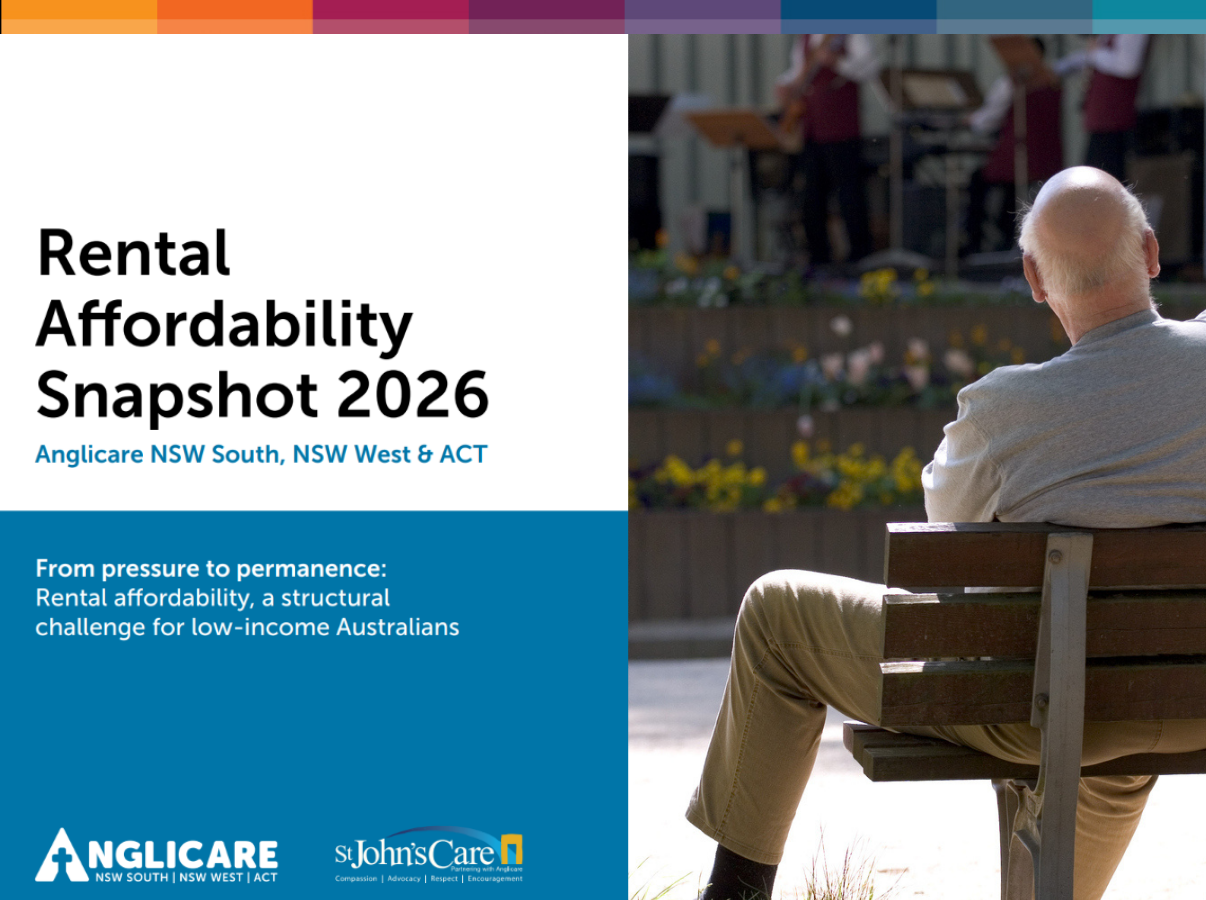
Anglicare’s 2026 Rental Affordability Snapshot (RAS), taken on 14–15 March 2026, shows just how deeply entrenched housing stress has become.
The Snapshot reviewed thousands of rental listings and found that the private rental market is failing to offer realistic housing options for anyone relying on income support payments — including the Age Pension, Disability Support Pension, Parenting Payment and Youth Allowance, or those earning the minimum wage.
Key findings:
- Less than 1% of listings were affordable and appropriate for households relying on Parenting Payment, Youth Allowance, Disability Support Payment, or JobSeeker
- Even dual‑income working families had limited choices meeting affordability and appropriateness thresholds
- Commonwealth Rent Assistance remains insufficient to bridge the gap between income and rents
- Regional areas no longer provide consistent affordability relief for low-income renters
- The private rental market is systematically failing to meet the housing needs of people on low incomes
The Snapshot confirms what Anglicare workers see every day: pressure on the rental market is now structural.
“There is just not enough housing to go around,” says Kaitlynd Gosling, Coordinator of Anglicare’s Eurobodalla Homelessness Support Service.
“We regularly see people shuffling between crisis accommodation, living in their cars or camping, and then back again. There are very few long‑term solutions in the area for those on lower incomes.”
On top of this, rising fuel prices — driven in part by global instability — are hitting regional communities particularly hard. Lower‑cost housing is often further away from services, employment and support, increasing transport costs for people who can least afford them.
As housing affordability continues to decline, demand for Anglicare’s services is rising sharply. Financial counsellors, emergency relief teams, housing and homelessness workers and volunteers are all supporting more people, often with increasingly complex needs — even as resources remain finite.
Anglicare Australia CEO Kasy Chambers says the findings highlight a fundamental failure of current housing settings.
“The private market is clearly not delivering. Even full‑time workers are being locked out, and people on Centrelink payments are seeing their options shrink year after year. Without decisive government action, low-income renters will remain locked out of meaningful housing solutions.”
Anglicare is calling on governments to act urgently by:
- Investing in social and affordable housing
- Strengthening renter protections
- Reforming capital gains tax to rebalance investment toward affordable housing
- Ensuring income support payments reflect the true cost of living, particularly in regional areas
Without change, stories like Doug’s will continue — not because people are failing to try, but because the system is no longer designed to include them.
Read our regional 2026 Rental Affordability Snapshot or review Anglicare Australia’s national 2026 Rental Affordability Snapshot.
*Names, images and identifying details have been changed to protect privacy.